The Mid-Year Pivot: Infrastructure Decisions Define Ecommerce Winners in H2 2026
The Widening Gap Between Ecommerce Leaders and Everyone Else
Halfway through 2026, the numbers on ecommerce performance tell a clear story. The average conversion rate across ecommerce sites sits at 2.86%, according to Digital Applied's 2026 benchmark data. Top-quartile performers convert at 5.6%, nearly double that rate. That gap has little to do with traffic volume or ad spend on their own. It reflects execution: how well a brand's checkout, product data, and customer experience function under real pressure.
That gap matters more now because shoppers are making fewer, more deliberate purchases. Salsify's 2026 consumer research found daily online shopping has fallen from 21% of shoppers to just 9% over the past year, as people consolidate purchases and comparison-shop more before buying. Every visit now carries more weight, which raises the cost of a site that doesn't convert on the first serious attempt.
For mid-market and enterprise brands planning H2 budgets right now, this is the number that matters more than any single trend headline. A brand at the median sits within reach of the top decile, competing against a smaller set of operators who have already done the unglamorous work of fixing what's broken beneath the surface. Growth in H2 2026 comes from closing that gap through deliberate technical investment across search visibility, infrastructure, personalization, and unified data.
Generative Engine Optimization: What AI Shopping Assistants Actually Need
That change in shopper behavior traces back to a genuine surge in AI-driven discovery. Adobe Analytics found traffic from AI engines to U.S. retail sites was up 393% year over year in the first quarter of 2026, following a 693% surge during the 2025 holiday season. Separately, Salsify found that roughly a fifth of shoppers (22%) now use AI tools to research products before they buy.
Inside Arctic Leaf's client accounts: teams across the portfolio are prioritizing SEO work built specifically for AI discovery, and Google Analytics data is showing measurable jumps in AI-referred sessions as a direct result. Platform-level support for this is arriving fast: Klaviyo's Composer, Shopify's Sidekick, and Google Analytics' Advisor have all shipped native AI assistants in the past few months, and each is becoming core to how its platform functions.
Retailers now call the technical discipline behind this generative engine optimization, or GEO; building product feeds, schema markup, and content in a format AI systems can parse and trust. The payoff is measurable. Adobe's Q1 2026 Digital Insights analysis found that by March 2026, AI-referred traffic to retail sites was converting 42% more often than the rest of a brand's traffic combined — a sharp reversal from March 2025, when AI traffic converted 38% worse than other channels.
Capturing that traffic requires specific technical work: clean product schemas, structured FAQs, and inventory data updated in real time. GEO functions as an ongoing content and data discipline. Brands that build a maintenance cadence around it, refreshing schemas and product data on a set schedule, keep that 42% advantage as competitors work to close it.
Why Infrastructure Investment Pays Off in a Tighter Economy
That same push toward AI-driven discovery is compounding with a broader complexity problem. DHL's 2026 Ecommerce Trends Report found 70% of shoppers now buy internationally, up from 60% the year before, with 45% crossing borders more than once a month. Every one of those transactions runs through the same operational layer. Tax and compliance rules, currency handling, fulfillment routing, and product data that stays accurate across markets.
Tom Wicky, cofounder and CEO of MyFBAPrep, made this point plainly in a recent Forbes Council piece on ecommerce fulfillment:
"I think it can be helpful to think of compliance as critical infrastructure, rather than an inconvenience."
The same logic extends into every operational system a brand runs on. A personalization engine built on inconsistent customer data will misfire. A GEO strategy built on outdated product feeds will surface wrong prices and out-of-stock items to AI assistants, damaging the trust those systems place in a brand's data.
In a tighter economy, with financing harder to secure and margins under closer scrutiny, this operational layer becomes the real constraint on growth. Fixing it produces a checkout that converts, a product feed AI systems can trust, and a customer record complete enough to personalize against, results that compound revenue quietly, month over month, long after any single front-end trend has faded.
Personalization That Understands Intent, Not History Alone
With more AI-generated content circulating in every category, distinctiveness now comes from producing original material built around a specific brand and its actual audience.
Arctic Leaf's take: more AI-generated content in the market is not a reason to avoid AI tools. It's a reason to aim them at something specific; a brand's actual voice and its actual customer, rather than a generic template every competitor is running through the same prompt.
Content and design
That same principle shows up in design. Several 2026 web design trend reports point to a shared movement. A return to visual personality, hand-drawn illustration, texture, bolder color, as a counterpart to the polished, AI-generated sameness now common across ecommerce sites.
Bento-style block layouts are organizing product pages the way people naturally scan them, and lightweight 3D or AR product views are becoming standard for reducing purchase hesitation. The common thread across content and design is direction: original work built around a specific, real customer profile.
Reaching the right audience
Where Arctic Leaf steps in: not every brand has a clear read on that audience yet. For those that don't, Arctic Leaf's user research draws directly from a client's existing stack, GA4, Hotjar, Klaviyo analytics, and Shopify analytics, to build a current picture of exactly who is already buying and why, before any content or design direction gets set.
Personalization compounds fastest in email. CLEARgo's guidance for Shopify Plus merchants shows advanced personalization strategies driving conversion rate improvements of 15% to 25%. Repeat purchase rates vary heavily by category, with consumable products like supplements and beauty targeting 40% to 60%, well above the 15% to 25% typical for durable goods like electronics and furniture.
Inside Arctic Leaf's client accounts: clients running dynamic content blocks built on real customer data report the same pattern firsthand. Deliverability scores climb, opens increase, and unsubscribes drop.
Platform-level data confirms the scale of this pattern industry-wide. Klaviyo's data across more than 183,000 brands shows automated, triggered flows generating 41% of total email revenue from just 5.3% of send volume, dramatically outperforming manual campaigns. Personalized subject lines built from real customer data such as abandoned cart items, past purchases, loyalty milestones, see open rates roughly 50% higher than generic sends, according to a large-scale email study by FulcrumTech.
Send timing has moved too! An analysis of more than 79,000 real marketing emails from Q2 2026 found the once-wide weekend send gap has narrowed to about 4%, down from close to 19% a year earlier, with Friday still leading and Saturday and Sunday close behind.
Unified Commerce: One Data Source Across Every Channel
Buy online, pick up in store has become a baseline expectation for shoppers. Meeting that expectation, along with supporting real-time inventory accuracy and consistent customer profiles across web, app, and physical retail, requires a single source of truth behind every channel.
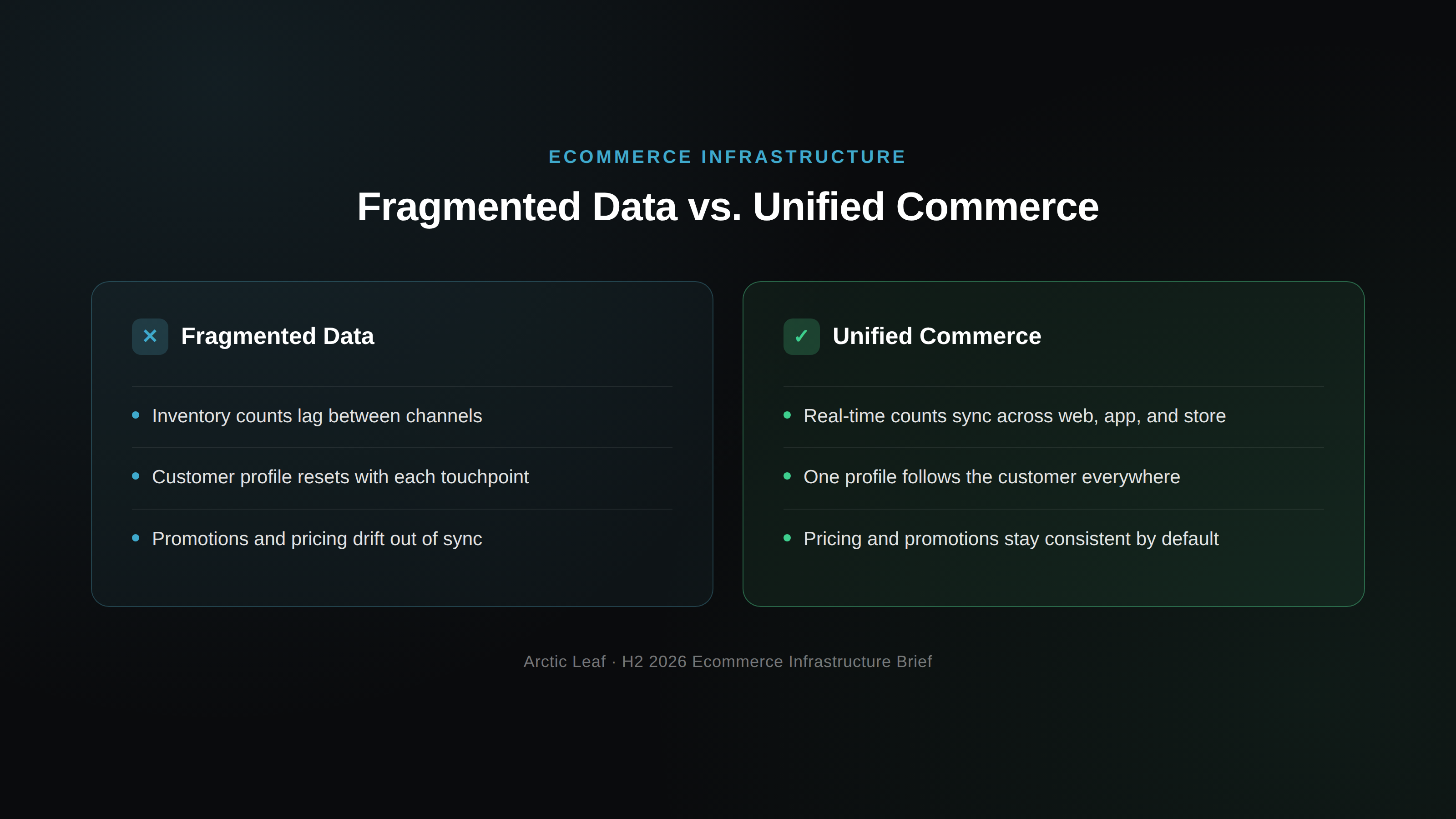
Salesforce's research on unified commerce points to the same conclusion: connecting online and offline data gives a brand real-time customer insight that siloed systems simply can't produce. This becomes the technical prerequisite for the next phase of AI-managed commerce, where systems handle cross-channel logistics and fulfillment decisions on a brand's behalf. Unified commerce is the foundation that makes agentic commerce possible at all.
What This Means for H2 2026 Planning
Every trend covered here points toward the same operational priority for H2 planning. The technical execution behind the scenes decides who converts, retains, and scales through Q4.
-
Generative engine optimization determines whether AI shopping assistants recommend a product at all, and that traffic converts 42% more often than the rest of a site's traffic.
-
Infrastructure work, meaning compliance, cross-border operations, and data pipelines, is what allows every front-end investment built on top of it to perform as intended.
-
Original content, distinctive design, and a clear read on the real audience now carry more weight than volume of output, especially as AI-generated content becomes the default across every category.
-
Personalization built on real customer data delivers a 15% to 30% conversion lift in email and moves repeat purchase rates toward the top of their category range.
-
Unified commerce across online and offline channels is the technical foundation agentic commerce and AI-managed logistics will require going forward.
Building the Infrastructure Ecommerce Brands Need for H2
Arctic Leaf works at the intersection of technical ecommerce development and performance marketing, building the systems described above for Shopify Plus merchants and DTC brands preparing for their busiest quarter of the year. Custom ecommerce design and development, structured data and GEO implementation, UX design and CRO work grounded in actual customer behavior, user research to define a brand's real audience, and email marketing programs built on clean data all come from the same discipline; fixing the infrastructure first so everything built on top of it performs the way it should.
Before Q4 arrives, it's worth answering one direct question. Which of these concerns you most right now?
AI search visibility, meaning whether your product data is structured well enough for AI shopping assistants to find and trust it. On-site experience, meaning whether your site's design and UX are keeping pace with what shoppers now expect. Ad spend efficiency, meaning whether your spend is converting or propping up a leaking funnel. Retention and lifetime value, meaning whether repeat customers are coming back, and personalized enough to stay.
Arctic Leaf offers a complimentary mini audit matched to whichever answer lands closest: an AI audit for search visibility and ad spend questions, a UI/UX audit for on-site experience, and an email marketing audit for retention and lifetime value. The brands closing the conversion gap this year are answering that question in Q3, well ahead of the November crunch.