E‑Commerce Growth for B2B Brands: Strategies Beyond Traditional Funnel Tactics
Key Takeaways
-
Global B2B ecommerce reached $32.11 trillion in 2025 and continues climbing toward $36 trillion in 2026.
-
Over half of B2B buyers now start research with AI chatbots, making structured product data essential for supplier visibility.
-
Shopify extended company accounts, custom pricing catalogs, and net terms to every paid plan in April 2026.
-
Net payment terms correlate directly with higher order frequency and larger average order values.
-
Fixing pricing structure, ERP integration, multi-user accounts, content strategy, and checkout produces measurable revenue movement fast.
B2B Ecommerce Strategy
How Brands Can Grow Revenue in 2026
The State of B2B Ecommerce
Global B2B ecommerce reached $32.11 trillion in 2025 and is projected to climb to $36 trillion in 2026 at a 14.5% compound annual growth rate. By the end of 2025, 80% of B2B sales are expected to happen digitally, up from just 13% in 2019, and the share of B2B revenue coming from digital channels has grown from 32% in 2020 to 56% in 2025. One in five B2B companies plans new ecommerce investment in the coming year. Heavy industries including advanced manufacturing, healthcare, and energy are driving the largest share of this growth, well ahead of traditional wholesale and retail sectors. This growth reflects a broader move toward digital commerce spreading into nearly every corner of B2B.
This and more is described clearly in Shopify’s B2B Ecommerce Trend Report.
The money is moving online, but the experience has not caught up. Despite this level of investment, 45% of B2B buyers report dissatisfaction with the customer experience their suppliers currently offer online, and 65% say they would pay more to a vendor who delivers a better one. A brand that closes this gap captures revenue a competitor is actively losing.
Notes on AI
B2B research behavior has already changed. AI is reshaping commerce research at a pace few B2B brands have adjusted to yet. G2's April 2026 data shows 51% of B2B buyers now start their research with AI chatbots more often than with traditional search engines. A buyer evaluating suppliers may never type a query into Google at all. They ask an AI tool directly, and the tool answers using whatever product data it can find and trust.
Shopify's Winter 2026 "RenAIssance" edition responded to this directly with Agentic Storefronts, a feature that lets products surface inside AI chat platforms including ChatGPT, Microsoft Copilot, and Perplexity, so a buyer can discover a supplier's catalog while still in the research phase, before ever landing on the storefront itself.
The practical requirement behind all of this is data quality. Product specs, pricing, and availability need to stay accurate and structured, because AI tools pull from that data directly when building a recommendation. A supplier with a clean, current product feed gets cited. A supplier with gaps or stale numbers gets skipped. Being present and well reviewed on third-party platforms like G2, Gartner, and industry-specific review sites matters more now too, since AI tools frequently draw from these sources when forming an answer. This is what content marketing means now: earning a citation inside an AI-generated answer.
B2B Major Players at a Glance
Platform choice sets a hard ceiling on what a B2B ecommerce strategy can do without custom development. The table below compares where native B2B functionality actually lives on each major platform, and what it costs to reach it.
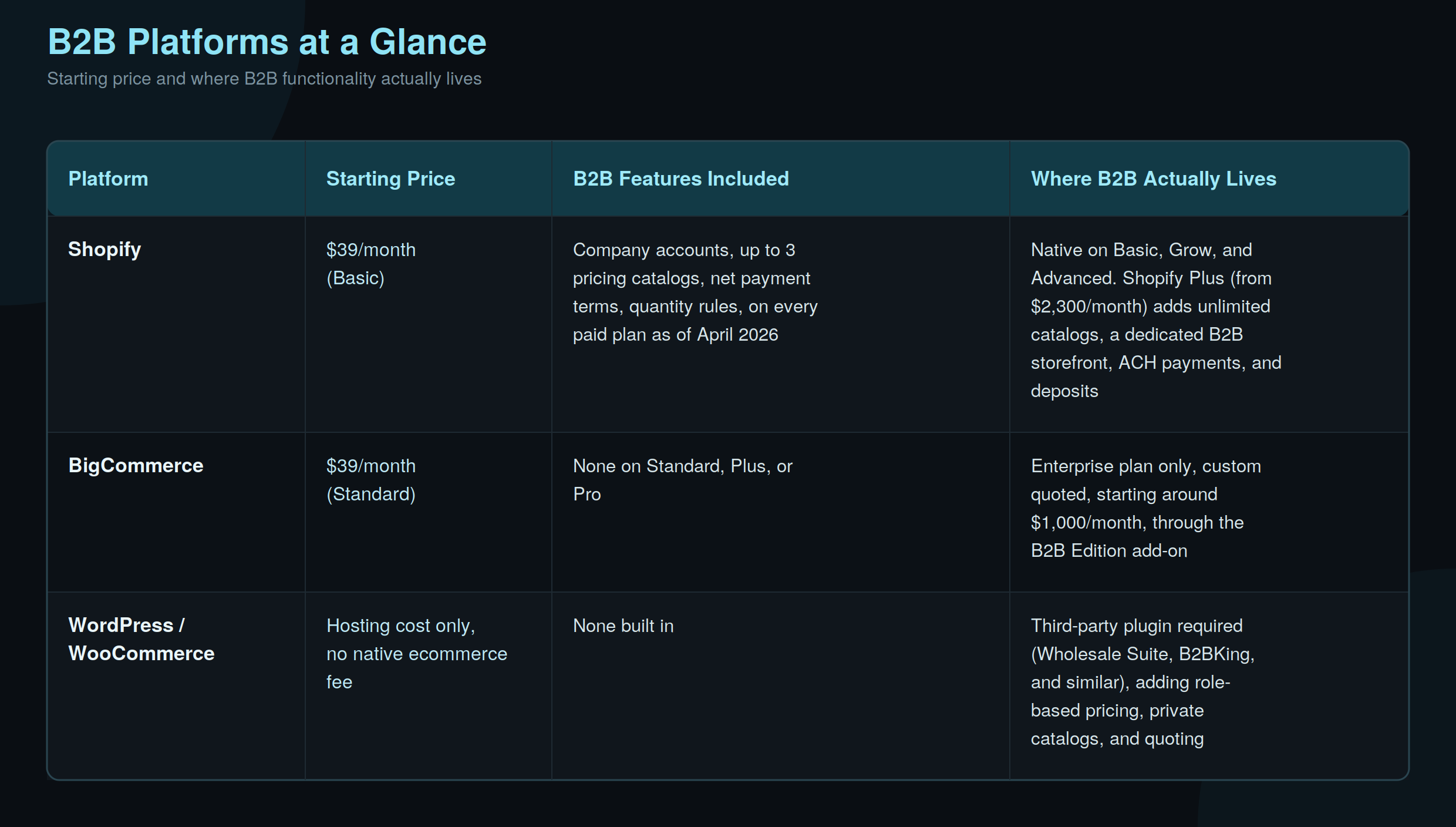
Shopify's decision to extend company accounts, custom catalogs, and net terms to every paid plan in April 2026 removed the single biggest cost barrier that used to sit between a growing wholesale brand and a proper B2B storefront. BigCommerce still gates its comparable functionality behind an Enterprise contract. WordPress requires assembling functionality through plugins that were not built by the same team and do not always work cleanly together. The practical result: a brand evaluating platforms for B2B in 2026 should weigh not just the sticker price on the comparison table, but how much custom development sits between that price and an actual working commerce platform.
Buyer Expectations and Relationships
A Forrester analysis found that 74% of B2B customers now expect self-service portals with account-specific pricing, order tracking, and quote history. Buyers still want a relationship with a rep at certain points in the sales cycle. What has changed is when and how often they want a human involved. Research from McKinsey describes a rule of thirds that has held steady among business buyers in B2B purchasing: roughly one third of purchases happen in person, one third with a sales rep, and one third entirely self-serve.
Buyers move between these modes constantly within a single purchase, and they expect quotes, order history, and pricing to carry across every one of them without friction.Net payment terms build this kind of customer relationship in a very direct, measurable way. Buyers offered net terms show 35-45% higher order frequency and 20% higher average order values than buyers on prepay only. Extending credit is a trust signal, and buyers respond to it with loyalty and larger orders. A brand that treats its B2B customers as relationships to build, rather than transactions to process, ends up with a much stronger repeat customer base than one chasing first-time wholesale orders alone.
5 Changes You Should Make Right Now
Most B2B ecommerce problems trace back to five areas. Fixing these produces measurable revenue movement faster than almost anything else on a B2B roadmap.
1. Fix Your Pricing Structure
Assign pricing through catalogs or customer groups tied to specific companies, not a flat rate applied to everyone. On Shopify, a catalog carries a fixed wholesale price, a percentage discount from retail, or a cost-plus calculation, and gets assigned to one or more companies. Pair this with net terms: start new accounts on prepay or Net 15, move them to Net 30 after three to six months of on-time payment, and reserve Net 60 for accounts with over $100,000 in annual volume. Handled this way, pricing, terms, and account history all live inside one unified commerce system anchored to each account.
2. Integrate With Your ERP
Integrating inventory and pricing data with an ERP or CRM system ranks as the most cited operational challenge in B2B ecommerce implementation. Shopify Plus raises API limits by 500% over standard plans to support real-time sync with systems like NetSuite and standard SAP configurations. Highly customized ERP environments, such as Prophet 21, Infor, or a heavily modified SAP or Dynamics instance, generally need middleware or a dedicated integration build. Modern commerce depends on this integration working quietly in the background, keeping pricing and stock accurate the moment a buyer checks them.
3. Design for Multiple Buyers Inside One Account
A B2B purchase rarely involves one person. A purchasing manager places the order, a finance lead approves the spend, and a warehouse contact tracks the shipment. Shopify's company accounts support multiple authorized users per company, each with a defined role, so B2B customers like purchasing managers and finance leads can place reorders and view full order history without looping in a sales rep for routine activity. Store credit can even be issued at the company location level, becoming available to any authorized buyer at that location.
4. Build Content Around How Buyers Actually Search
A highly specific, technical search phrase might pull only 40 searches a month, and those 40 searches represent exactly the buyer actively evaluating a solution right now. Build content around the precise language a procurement lead types, not broad industry terms that draw traffic without buying intent. This kind of targeted digital marketing turns content into a filter that pulls in potential customers already looking for a solution. Keep product data structured and current, since AI research tools pull directly from it.
5. Treat Checkout as Ongoing Work
A B2B checkout needs a purchase order number field, automatic tax-exempt handling per company, and vaulted payment methods for fast reordering. Test checkout with the actual roles involved in a real purchase, the buyer placing the order and the approver signing off on it, rather than a single generic user. A friction point invisible in a single-user test often surfaces the moment an approval step enters the flow. Getting this right protects the customer experience at the exact moment revenue changes hands.
Succeeding in B2B Ecommerce in 2026
None of this requires a full platform rebuild or a multi-year roadmap. Shopify's own numbers back this up directly: merchants who adopt B2B on Shopify report up to a 33% increase in self-serve orders within six months and up to a 20% lift in reorder frequency. A brand willing to fix pricing structure, connect its systems, design for real buying roles, and treat content and checkout as ongoing work has a genuine path to outgrowing competitors still running B2B like it is 2019.
Taken together, these five changes already form the outline of a working B2B ecommerce marketing strategy for any brand ready to execute on it. The brands winning wholesale accounts in 2026 are not necessarily the ones with the biggest catalog or the longest history. They are the ones that made their storefront as easy to buy from as a rep on the phone, and then kept improving it every quarter instead of letting it sit. In the process, they are quietly setting the pace for what B2B commerce looks like across their entire category.
Arctic Leaf works inside this exact space as a Shopify Premier Partner, building custom ecommerce design and development, bespoke web and mobile solutions, UX design, conversion rate optimization, software development, and email marketing built around real account behavior. That includes structuring company accounts and pricing catalogs correctly from day one, building the ERP integration when a standard connector does not fit a customized system, and running the ongoing CRO work that turns a functional B2B storefront into one that keeps growing. Every piece of that work points at the same outcome: a customer experience that holds up whether a buyer orders through a rep, a portal, or an AI tool searching on their behalf.
Frequently Asked Questions
Should B2B brands sell through Amazon's marketplace or their own storefront?
Amazon Business gives B2B brands fast access to a large, already-active pool of buyers. Selling there means competing on price inside a marketplace controlled by someone else, with limited control over pricing, checkout, and brand presentation. Most manufacturers and distributors treat this marketplace as one additional channel alongside their own direct storefront, keeping the direct channel focused on margin, contract pricing, and account data that belongs to the brand itself. It is not the only B2B marketplace worth watching either, and evaluating a few options before committing product data to any single one is worth the extra week of research.
What counts as a company account in B2B ecommerce?
A business customer in B2B ecommerce is an organization, such as a distributor, retailer, or manufacturer, purchasing products for resale, internal use, or further production, typically through a company account with its own pricing, terms, and authorized buyers. This account usually orders in volume, on a recurring basis, through an approval process involving more than one person.
How does content fit into supplier discovery and marketing?
Content and search visibility function as a marketing effort in their own right inside B2B ecommerce. A modern B2B marketing plan accounts for how buyers discover suppliers through AI tools, structured product data, and third-party review platforms, alongside traditional search. Global commerce is moving in this direction across every category, and B2B brands that treat content as part of commerce infrastructure tend to show up more often in these AI-driven research moments.
What is a B2B ecommerce strategy?
A B2B ecommerce strategy is the combined plan for how a business sells to other businesses online: the self-service buying experience, contracted pricing structure, multi-user account design, backend system integration, content and search visibility, and checkout process. A strong B2B ecommerce strategy treats each of these as connected, since a gap in one area, like an ERP that does not sync inventory, undermines the rest of the buying experience regardless of how polished the storefront looks.
How is B2B ecommerce different from B2C ecommerce?
B2C ecommerce optimizes for a single buyer making an impulse or convenience-driven purchase at a fixed price. B2B ecommerce involves negotiated contract pricing, multiple authorized buyers per account, approval workflows, purchase order numbers, net payment terms, and often much larger order volumes. The technical requirements for a B2B ecommerce platform run considerably deeper as a result, and a platform built only for consumer checkout flows will hit its limits fast once real B2B accounts start placing orders.
Does Shopify support B2B ecommerce?
Yes. As of April 2026, Shopify includes foundational B2B ecommerce features on every paid plan: company accounts, up to three custom pricing catalogs, volume discounts and quantity rules, net payment terms, and vaulted credit cards. Shopify Plus adds unlimited catalogs, a dedicated B2B storefront, ACH payments, deposits and partial payments, store credit at the company location level, and checkout customization through Shopify Functions.
What features should a B2B ecommerce platform have?
At a minimum, a B2B ecommerce platform needs company account management with multiple authorized users per account, customer-specific pricing catalogs, net payment terms, a self-service buyer portal with order history and reorder tools, and integration capability with your ERP or CRM system. Quote request workflows, purchase order support, and role-based approval permissions matter for any brand selling to distributors or resellers with negotiated terms and internal spend controls.
How do I price products for B2B ecommerce customers?
Most B2B brands assign pricing through catalogs or price lists tied to specific companies or customer groups: a fixed wholesale price, a percentage discount from retail, or a cost-plus calculation. Pair this with net payment terms, such as Net 15, 30, 60, or 90, based on account history and order volume, and automate the terms upgrade as an account proves reliable rather than reviewing every account manually.
Is BigCommerce good for B2B ecommerce?
BigCommerce's B2B Edition, available only on the Enterprise plan, covers company accounts, customer-specific pricing, quote management, and a self-service Buyer Portal with a quick order pad. It fits brands with a strong DTC foundation adding a straightforward wholesale channel well. Brands with highly complex, multi-tier approval workflows or heavy negotiated contract pricing may need custom development layered on top of the native B2B Edition tools to cover every scenario.
Can WooCommerce handle B2B ecommerce?
Default WooCommerce includes no B2B ecommerce functionality. Plugins like Wholesale Suite and B2BKing add role-based pricing, private catalogs gated by login, tiered volume pricing, and quote request workflows. WooCommerce B2B ecommerce setups generally require more manual configuration than Shopify or BigCommerce, since the functionality comes from third-party plugins rather than the core platform, and combining multiple plugins for a full workflow can introduce conflicts if they are not built to work together.
How long does it take to launch a B2B ecommerce store on Shopify?
Activating native B2B on an existing Shopify store, with up to three catalogs and standard payment terms, typically takes two to four weeks of configuration. A brand migrating off a legacy wholesale platform, or building custom ERP integration and checkout logic, should plan for a longer timeline built around that specific scope of work, since data migration and account recreation add real time on top of basic setup.
What is the biggest challenge in B2B ecommerce?
Integrating inventory, pricing, and order data with existing ERP and CRM systems ranks as the most frequently cited challenge in B2B ecommerce implementation. A storefront disconnected from these systems shows buyers stale pricing or inaccurate stock, which erodes trust in the self-service experience faster than almost any other issue, even when the rest of the storefront is well designed.
How does AI search affect B2B ecommerce strategy?
More than half of B2B buyers now start research with AI chatbots rather than traditional search engines. This makes structured, accurate product data a direct requirement rather than a nice addition, since AI tools pull from that data to build supplier recommendations. Shopify's Agentic Storefronts feature reflects this shift directly, letting products surface inside AI chat platforms while a buyer is still in the research stage of their purchase.
Should B2B ecommerce run on the same store as DTC sales?
Most brands benefit from running B2B and DTC from one blended store, since a unified backend simplifies inventory, reduces operational overhead, and lets a brand serve both retail and wholesale buyers from the same product catalog. Separate stores make sense only when a wholesale channel is owned by a distinct commercial team with its own reporting structure, since combining the two in that case can complicate attribution rather than simplify it. This kind of unified setup increasingly defines wholesale commerce in 2026, since buyers expect one account across every channel a brand sells through.
How do I get B2B buyers to place larger, more frequent orders?
Volume-based pricing tiers, net payment terms, and one-click reordering from past purchases all directly increase order size and frequency. Buyers offered net terms already show meaningfully higher order frequency and average order value compared with prepay-only accounts, and a quick order pad or saved shopping list removes the friction of rebuilding a large cart from scratch every time a buyer reorders the same core products.
What is the average order value in B2B ecommerce?
Average order value varies heavily by industry and product category, but it consistently runs well above typical B2C order values because B2B purchases involve bulk quantities, contracted volume, and recurring restock cycles rather than single-unit consumer purchases. Brands that add net payment terms and volume pricing tiers see average order values climb further, since a buyer with approved credit and a bulk discount has less reason to hold back on quantity. Cross-border commerce further complicates this benchmark, since currency, tax, and shipping costs vary company to company.
How do I choose between Shopify, BigCommerce, and WordPress for B2B ecommerce?
The right platform depends on where the wholesale operation already sits and how much native functionality it needs on day one. Shopify offers the broadest native B2B feature set across every paid plan, which makes it a strong fit for a brand that wants company accounts, custom pricing, and net terms working without a heavy custom build. BigCommerce's B2B Edition suits a brand already committed to the platform for DTC and adding a relatively straightforward wholesale channel on top. WordPress and WooCommerce fit a brand that already runs on WordPress for other reasons and is comfortable configuring wholesale functionality through a combination of plugins rather than a single native system. For most manufacturers, distributors, and wholesale brands building B2B ecommerce from scratch in 2026, Shopify's native feature set and lower barrier to entry make it the platform worth building the strategy around first.
Which industries are driving B2B ecommerce growth right now?
Advanced manufacturing, healthcare, and energy currently account for the largest share of B2B ecommerce sales, growing faster than traditional wholesale and retail channels. Global energy and materials, telecommunications, media and technology, and advanced industries sectors are also seeing a notable rise in decision-makers willing to commit to very large B2B transactions, a shift that is especially pronounced in China, India, and the United States. These sectors are early adopters of self-service commerce tools now spreading into other B2B categories. Brands operating in adjacent categories can look to these sectors for an early signal of which B2B ecommerce capabilities are about to become standard buyer expectations rather than a competitive edge.
How much does BigCommerce B2B Edition cost?
BigCommerce B2B Edition is not included on the Standard, Plus, or Pro plans. It is available only as an add-on to the Enterprise plan, which is custom quoted based on projected sales volume and integration needs, with a starting rate generally cited around $1,000 per month. This makes BigCommerce's path to B2B functionality considerably more expensive at the entry point than Shopify, which includes company accounts, custom pricing catalogs, and net terms on its $39-per-month Basic plan as of April 2026.
What is a self-service B2B buying experience?
A self-service B2B buying experience lets a logged-in buyer see their negotiated pricing, place an order, check inventory, track a shipment, and request a reorder without contacting a sales rep for any of it. It does not eliminate the sales relationship. It shifts routine, repeat activity away from a rep's inbox and phone line, freeing that rep to spend time on new accounts and complex negotiations instead of processing orders a buyer could have placed themselves in under a minute.
Why are B2B buyers dissatisfied even as ecommerce investment increases?
A meaningful share of B2B buyers report dissatisfaction because the investment often goes into the wrong layer of the experience. A brand may launch a modern storefront while leaving pricing generic, checkout disconnected from real approval workflows, or inventory data out of sync with its ERP. Buyers notice the layer that is broken regardless of how much was spent elsewhere, which is why a B2B ecommerce strategy needs to treat pricing, backend integration, account design, content, and checkout as one connected system rather than a list of separate upgrades.
Do B2B buyers still want a relationship with a sales rep?
Yes, and this is one of the more misunderstood parts of B2B ecommerce growth. Research describing a rule of thirds in B2B buying shows purchases still split roughly evenly between in-person, rep-assisted, and fully self-service, with buyers moving between all three during a single purchase decision. Adding self-service tools does not remove the sales relationship. It gives a rep more room to focus on larger accounts, renewals, and new business, since routine reorders and standard pricing questions get handled by the storefront directly. Net payment terms strengthen this relationship further, since extending credit signals trust and consistently correlates with higher order frequency and larger average order values from the accounts that receive it. A B2B ecommerce strategy built around this reality treats self-service and relationship selling as partners working toward the same revenue goal, rather than two competing approaches to the same buyer.